
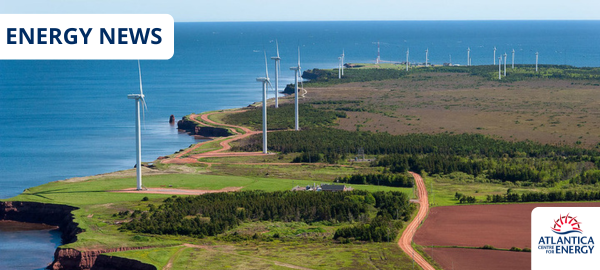
Prince Edward Island (PEI)

Prince Edward Island releases new energy strategy

2025-10-29T10:33:30+00:00October 29th, 2025|Energy news, Energy Stories, Featured, News, Uncategorized|

On Wednesday, October 29th, the Government of Prince Edward Island released its new energy strategy, which calls for strengthened consumer protections, upgrades to infrastructure, and regional collaboration.  The strategy outlines a long-term vision for the Government of Prince Edward Island’s energy priorities through 2035. The province is building on its previous energy strategy by

Prince Edward Island’s Climate Challenge Fund (CCF) 2026/2027

2025-11-26T02:42:57+00:00October 29th, 2025|Energy news, Energy Stories|

The Government of Prince Edward Island’s Climate Challenge Fund is now open for 2026–27 applications! Established in 2020, the Climate Challenge Fund (CCF) continues to support innovative climate action projects that align with Prince Edward Island’s Net Zero Framework and the Building Resilience: Climate Adaptation Plan. The CCF helps individuals and organizations build the skills,

Member Spotlight: PEI Energy Corporation and the PEI Energy Blueprint

2024-05-29T01:53:43+00:00February 27th, 2024|Energy Stories, News|

Andrew Halliday, Director of Policy and Planning, of the PEI Energy Corporation, the provincial crown utility, presented at the Energy Fundamentals for Leaders, a program offered to professionals through UNB’s Saint John College and facilitated by the Atlantica Centre for Energy. Andrew was asked to discuss the PEI Energy Blueprint Discussion Paper, and the

Atlantic Canada’s Electricity Future – Discussion Series Part 2: Electricity Demand

2024-11-05T18:36:15+00:00September 27th, 2022|Discussion Papers, Publications|

The purpose of the second discussion paper in Atlantic Canada’s Electricity Future – Discussion Series is to help Atlantic Canadians better understand how federal regulatory changes and policies aimed at achieving net-zero emission by 2050, as well as evolving consumer behaviours, will likely increase electricity demand across the Atlantic provinces. Like the first paper in

Go to Top