
Electricity is something most of us take for granted. We flip a switch and the lights come on. But behind that simple action is a complex system that needs precision and balance, second by second, across a large region. The people and organizations responsible for keeping that balance are called system operators.
What is a system operator?
An electricity system operator is the organization responsible for keeping the electricity grid running reliably in real time. Think of it like air traffic control; just as air traffic controllers must know the position and trajectory of every plane to maintain safety, system operators must know the output of every generator and the flow on every line to keep the grid stable in an ever-changing system.
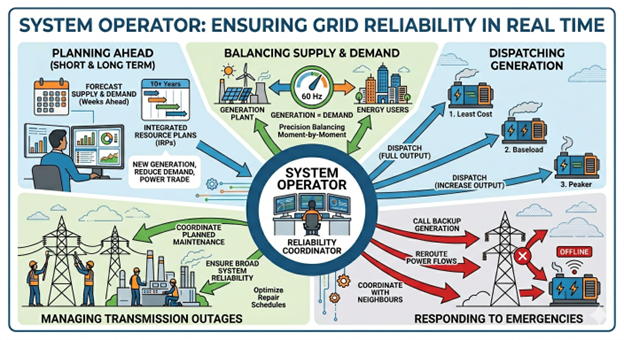
The primary responsibility of the system operator is to maintain reliability by monitoring and controlling the many elements of the electricity system. It assures compliance with North American Electric Reliability Corporation (NERC) reliability standards by controlling energy flows, maintaining required reserves, frequency and area control errors. The core responsibilities include:
- Balancing supply and demand: The amount of electricity flowing into the grid has to match the amount being used at all times, not just hour to hour, but moment to moment. Grid frequency must stay very close to 60 hertz – the standard for the Eastern Interconnection. If generation exceeds demand, frequency climbs. If demand outpaces generation, frequency drops. Either way, equipment can be damaged and outages can follow. To understand this better, read Balancing the grid 101
- Dispatching generation: When demand rises, system operators call on generators to increase output, starting with the least costly sources available. When demand falls, generators are instructed to reduce output or power down.
- Responding to emergencies: When a generator trips offline unexpectedly or a transmission line fails, system operators act immediately, calling on backup generation, rerouting power flows, and coordinating with neighbouring systems to keep the lights on.
- Managing transmission outages: System operators coordinate planned and unplanned maintenance outages across transmission lines and generating stations each year, ensuring repair work does not compromise broader system reliability.
- Planning ahead: Planning is a core and demanding part of the role. In the short-term, this means forecasting energy supply weeks ahead to spot potential shortfalls before they become problems. Over the longer-term, system operators develop strategies, often called Integrated Resource Plans (IRPs), that map out how a utility will meet customer demand over the next ten or more years. These plans weigh options like building new generation, reducing demand, or trading power with neighbouring provinces.
Note: Newfoundland and Labrador operates under a separate reliability framework and is not subject to NERC standards
Who are the system operators in Atlantic Canada?
In Atlantic Canada, electricity system operations are handled differently by province. There is no single regional decision-maker overseeing the whole system.
New Brunswick is served by NB Power’s Transmission and System Operator (T&SO) division. The System Operator is responsible for directing the operation of the transmission facilities and connected generation and load that make up the province-wide power system, and coordinates and operates interconnections with Québec, Nova Scotia, P.E.I. and New England. NB Power’s system operator also acts as one of only 15 Reliability Coordinators in North America, overseeing the reliable operation of the Maritimes area – New Brunswick, Nova Scotia, Prince Edward Island, and a portion of northeastern Maine.
Nova Scotia now has a system operator that is separate from the electric utility, The Independent Energy System Operator (IESO Nova Scotia). IESO Nova Scotia was established by provincial legislation in 2024 to take over long-term electricity system planning, procurement and transmission operations from Nova Scotia Power. The transition is happening in two phases: Phase 1 (transmission planning and procurement) was completed during the Winter 2025/26, and Phase 2 (real-time dispatching and control) is targeted for Spring 2027.
Prince Edward Island does not have its own system operator, NB Power’s system operator acts as the Reliability Coordinator for the Maritimes Area, which includes PEI.
Newfoundland and Labrador is served by the Newfoundland and Labrador System Operator (NLSO), a function within NL Hydro that is responsible for the safe and reliable operation of the province’s bulk electric system. NL Hydro is also the primary generator and transmitter of electricity across the province.
Why do system operators matter so much?
As electricity demand grows, driven by the electrification of heating, transportation, and industry, and as coal plants are retired and replaced with variable wind and solar generation, the complexity of managing the grid increases. More sources of generation, more variability in output, and more interconnection between provinces all mean that decisions made in one province have larger effects on neighbours than they used to.
External assessments reinforce this concern. NERC’s 2024 Long-Term Reliability Assessment forecasts declining reserve margins in the Maritimes assessment area over the planning horizon, meaning the cushion between available electricity supply and peak demand is shrinking, even before accounting for additional load growth or major project delays. NERC’s assessment of the region could improve through better integration of resources through Atlantic Canada because currently, NERC looks at each province as a standalone region.
The case for thinking regionally
Atlantic Canada’s electricity grid already functions as a regional system in physical terms, power flows across provincial borders through shared transmission lines. But the decision making about that grid remains organized by province. No single entity has both the mandate and the tools to plan and operate the system as an interconnected whole.
When provinces plan and invest independently, they may duplicate infrastructure that a shared system would not need. They may miss opportunities to draw on lower-cost generation in a neighbouring province. All of those inefficiencies and others could be adding pressure to electricity bills.
The scale of investment now required to replace aging infrastructure, retire coal generation, and build new clean electricity capacity is too large for small provinces to manage efficiently on their own. As the Atlantic Energy Collective and Crux Energy Consulting concluded in An Atlantic Canadian Energy Future (January 2026), a more integrated regional approach to planning and operation could deliver meaningful cost savings and reliability benefits across the region.
Regional System Operator
One option discussed in that context is the potential role of a regional system operator.
A Regional System Operator (RSO) is an organization that manages electricity system operations across more than one province or jurisdiction. Rather than each province running its own control room with its own priorities, a regional system operator would coordinate planning and operations with a full view of the interconnected system. Several models exist globally, from the integrated markets of PJM and MISO in the United States to the coordinated national operators of Scandinavia, offering potential templates for Atlantic Canada.
Resources
For more information on the topics covered in this article, visit:
- NB Power Transmission and System Operator
- IESO Nova Scotia
- Emera Newfoundland and Labrador – Maritime Link
- NL Hydro – How Our System Works
- Government of Nova Scotia – Legislation to Modernize Electricity System, Improve Regulation
- ISO New England – Operating the Power System
- ISO Newswire
- Canada Energy Regulator – PEI Energy Profile
- PJM Interconnection
- An Atlantic Canadian Energy Future(PDF – 758kb)
- NESO Balancing the Grid interactive game
- Energy 101: Balancing the grid
- Energy 101: Natural Gas Grid
- Energy 101: Electrical Grid