The four Atlantic provinces are different from most of their Canadian counterparts when it comes to buying petroleum fuels (gasoline, diesel, heating oil and propane). Unlike elsewhere in Canada, the Atlantic provinces regulate the prices of most or all these fuels. (Quebec stopped regulating gasoline and diesel prices in 2025).

What are petroleum fuel pricing regulations?

Petroleum fuel pricing regulations typically fix the price, the maximum price and/or the minimum price of petroleum fuels depending on the province and the fuel type.

Why do the Atlantic provinces regulate petroleum fuel prices?

Atlantic provinces started regulating petroleum fuel prices for several reasons. The Government of Newfoundland and Labrador started regulating gasoline, diesel, furnace and stove oil, and propane prices in 2001. The provincial government’s goal was to “restore consumer confidence and ensure price changes occur on a regular basis.” Petroleum fuel prices across the before were more volatile (many sudden high or low prices). Other public concerns prior to price regulation included a lack of transparency in retail prices, and supply certainty for smaller, rural retailers.

Who determines petroleum fuel prices in Atlantic Canada?

The power to regulate fuel prices lies with the provinces rather than the federal government (though the federal government has some authority to intervene in the case of a national emergency). However, just because they can, doesn’t mean that they do.

Not all provinces choose to regulate fuel prices. In the four Atlantic provinces, governments have chosen to do so through an independent energy or utility board or commission.

In Atlantic Canada, the regulators are:

  • The New Brunswick Energy and Utilities Board;
  • The Nova Scotia Energy Board;
  • The Island Regulatory and Appeals Commission (Prince Edward Island); and,
  • The Board of Commissioners of Public Utilities, also known as the Public Utilities Board (Newfoundland and Labrador).

Which petroleum fuel prices are regulated in Atlantic Canada?

The Atlantic provinces all use a similar structure to regulate petroleum fuel prices. Each province starts with a benchmark wholesale price; adds different mark-ups for sales margins, delivery costs, emission compliance; and adds taxes to get to final prices.

In New Brunswick and Newfoundland and Labrador, regulators set a maximum price. In Nova Scotia and Prince Edward Island, regulators set a price range (with minimum and maximum prices). Each province allows prices to vary based on regional zones (to capture added delivery costs).

How does each province regulate petroleum fuel prices?
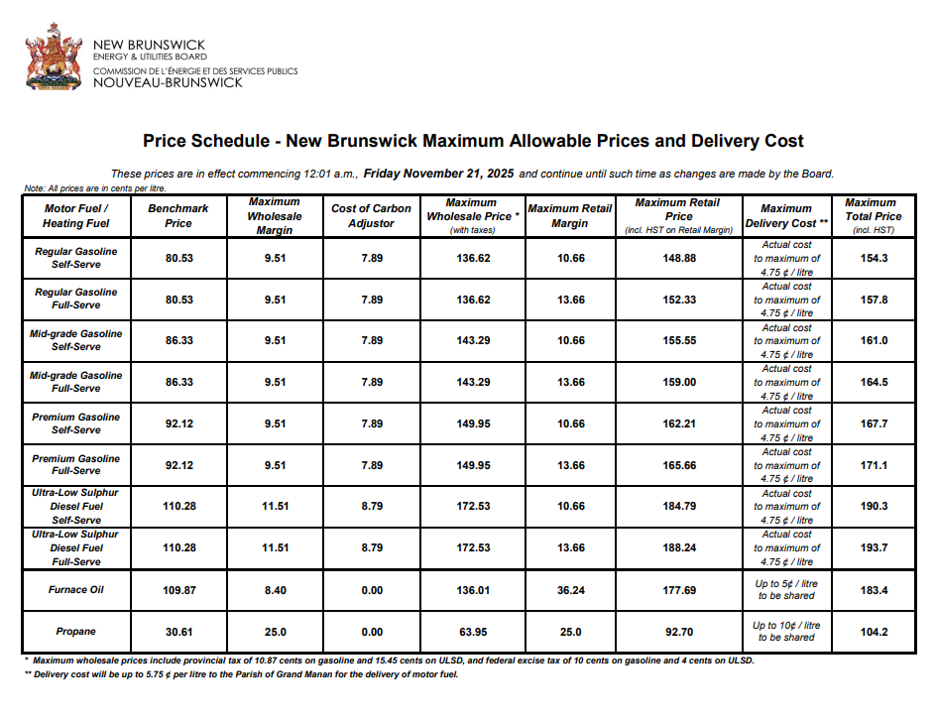
The New Brunswick Energy and Utilities Board regulates gasoline, diesel, propane and home heating oil prices.

  • How prices are set:
    • The NBEUB determines a benchmark price for the fuel using average prices on international markets. For gasoline, diesel and heating oils, the average New York Harbor Price is used. For propane, the Sarnia, ON market price is used.
    • The NBEUB then adds a maximum wholesale margin (6.51 cents per litre for gasoline and diesel, 5.5 cents per litre for furnace oil, and 25.0 cents per litre for propane). This cost covers wholesaler’s costs, such as storage costs and moving fuels from the refinery.
    • Taxes are charged on the benchmark price, wholesale price, and the carbon adjustor (if in place). These taxes can include the federal excise tax, the provincial gasoline and motive fuel tax, the federal fuel charge, and HST. These costs together make up the maximum wholesale price.
    • The NBEUB then adds the retail margin to the maximum wholesale prices. The retail margin is 8.46 cents per litre for gasoline and diesel (to cover costs of selling gasoline at a gas station, for example). HST is then added to the retail price. For heating oil, the retail margin is 27.21 cents per litre, and 25.0 cents per litre for propane.
    • Last, but not least, wholesalers are allowed to recover some actual delivery costs to certain areas of the province (up to 4.75 cents per litre for gasoline and diesel, except 5.0 centre per litre on Grand Manan). HST is then added to this delivery cost. For heating oil, the delivery cost is up to 5.0 cents per litre, and 10.0 cents per litre for propane.
    • Effective December 1, 2025, the Government of New Brunswick no longer has a Cost of Carbon Adjustor (added to gasoline and diesel motor fuels). However, on November 28, 2025, the NBEUB issued an interim order to pass along this Cost (7.90 cents per litre for gasoline and 8.81 cents per litre for diesel) on an interim basis while the Board more thoroughly reviews the costs relating to the Clean Fuel Regulations. A decision is expected in February, 2026.
  • Review frequency: The NBEUB reviews regulates petroleum fuel prices weekly and updates them effective each Friday.

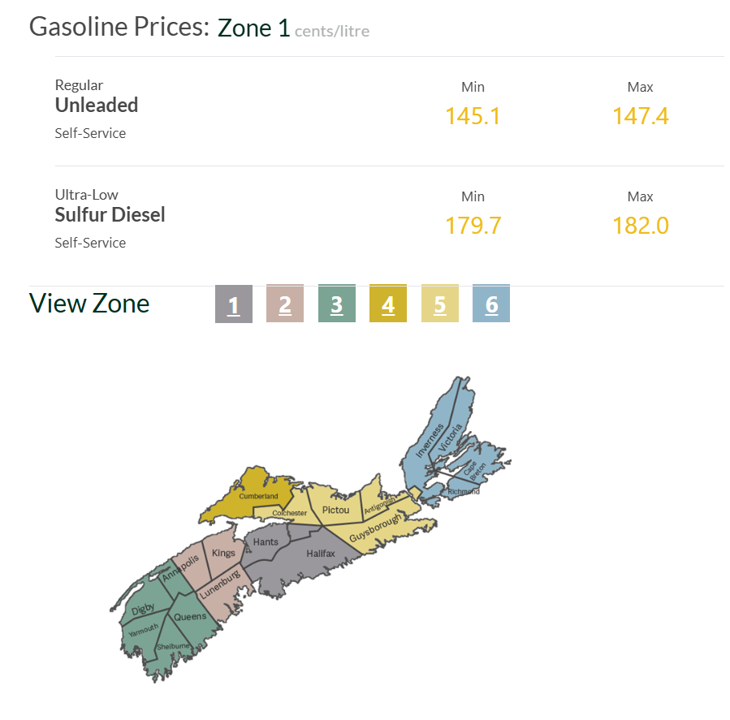
The Nova Scotia Energy Board currently regulates gasoline and diesel (used in motor vehicles).

  • How prices are set:
    • The Nova Scotia Energy Board (NSEB) first determines a benchmark price, based on recent averaged market prices on the New York Harbor, except ethanol.
    • A wholesale margin is added to the benchmark price to capture costs that wholesalers incur (storage, transportation). For gasoline, this mark-up is currently 13.84 cents per litre.
    • The NSEB includes a transportation allowance for wholesales depending where they are delivering to, such as 2.0 cents more per litre for diesel delivered to Sydney (Zone 6) compared to Halifax (Zone 1).
    • The Clean Fuel Adjustor is applied (currently 5.46 cents per litre for gasoline). On November 25, 2025, the NSEB approved a revised methodology for calculating the Adjustor, which will take effect on January 9, 2026.
    • A retail minimum and maximum mark-up is allowed by the NSEB, to help cover retail costs such as storage tanks and operating pumps, and to allow for a reasonable profit. This mark-up is 5.4 cents per litre for gasoline, and an additional 0.2 cents per litre cost can be added to payment processing costs (such as credit card fees).
    • Finally, taxes are added including the federal excise tax, the provincial motive fuel tax, and HST.
  • Review frequency: The NSEB reviews and adjusts prices on a weekly basis, effective each Friday.

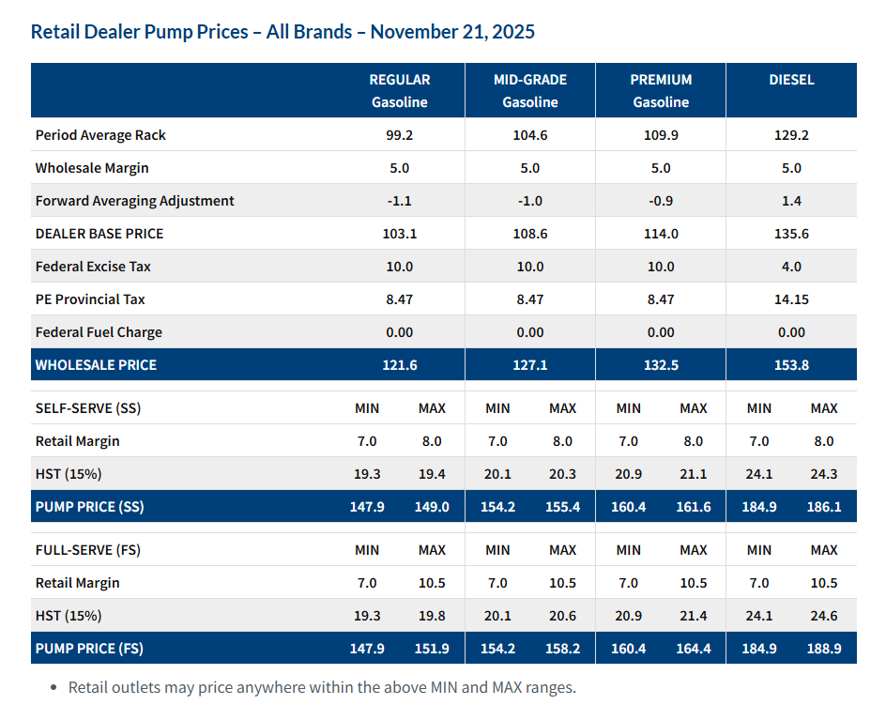
The Island Regulatory and Appeals Commission regulates gasoline, diesel, propane and home heating oil prices.

  • How prices are set:
    • The Island Regulatory and Appeals Commission (IRAC) first determines the Charlottetown rack price, which is the cost for fuel delivered to the Charlottetown terminal. This is a different process than what the other three Atlantic provinces use but has a similar result. The rack price captures all refiner costs, including those related to the federal Clean Fuel Regulations.
    • IRAC then adds a wholesale margin (e.g., 0 ¢/L for gasoline and diesel) to the rack price. This margin helps wholesalers cover their costs like storage and transporting the fuel. Home heating oil has a combined wholesale and retail margin 23.1 cents per litre added.
    • Taxes are added to the combined wholesale price, which include the federal excise tax, and provincial Gas Tax. HST is charged one gasoline, diesel and propane, but only GST is charged on home heating oil.
    • A retail margin is added for gasoline and diesel of 7.0 cents or 8.0 cents per litre for self-serve (minimum and maximum prices ). HST is further charged on the retail margin.
    • IRAC also calculates a forward averaging adjustment, which helps correct for short-term prices swings and smooths margins on an annual basis.
  • Review frequency: Gas, diesel, heating oil prices are reviewed and adjusted every Friday. Propane prices are reviewed and adjusted every second Friday.

Board of Commissioners of Public Utilities (PUB) regulates gasoline, diesel, home heating oil and propane prices in Newfoundland and Labrador.

  • How prices are set:
    • The PUB determines a benchmark price for gasoline, diesel and home heating oil based on a 5-day average market price and reported by Argus Media. This average price reflects the New York Harbor price and is converted into Canadian dollars. A Sarnia, ON benchmark price is used for propane.
    • A wholesale mark-up is added to the benchmark price to cover the wholesaler’s costs such as storage and some transportation. These mark-ups are currently 15.65, 14.07 and 9.11 cents per litre for gasoline, diesel and home heating oil respectively.
    • A zone differential is also added to capture the difference in delivery costs to different parts of the province.
    • Retail mark-ups are added to cover retailers’ costs, such as storage, pumps and transaction fees. These costs are 14.28, 18.03 and 22.27 cents per litre for gasoline, diesel and home heating oil respectively.
    • The PUB adds a combined wholesale and retail mark-up for propane, which is either 56.09 or 69.6 cents per litre depending on the zone.
    • The PUB applies a carbon price adjustment (per-litre) to reflect the additional cost of suppliers related to the federal Clean Fuel Regulations. This adjustment is currently 5.40 cents per litre for gasoline and 6.02 cents per litre for diesel in most zones.
    • Federal and province taxes are added to these cumulative prices including the federal excise tax, the provincial gasoline tax, and HST. Maximum prices for heating fuels do not reflect taxation. The provincial gas tax was temporarily reduced from 14.5 cents per litre to 7.5 cents per litre in 2022, and the provincial government has committed to make this change permanent.
  • Review frequency: The PUB reviews and updates gasoline, diesel, home heating oil and propane prices weekly, effective each Friday, in most areas of the province. In most zones in Labrador, maximum price adjustments are suspended on a seasonal basis because they are supplied by marine tanker and may get products as little as twice a year.

Each Atlantic province’s regulations allow price interruptions or unscheduled adjustments to happen if there is a sharp increase or decrease in market prices (such as those seen in March 2020 and February 2022). These price interruptions allow regulators to reset the price before the scheduled date.

Fuel blending costs are also captured by provincial regulators, such as differences in winter and summer blending on biofuels in diesel.

What is a carbon adjustor cost?

New Brunswick, Nova Scotia and Newfoundland and Labrador currently allow specific price increases relating to the federal Clean Fuel Regulations (CFR). The prices and names of this carbon price vary slightly by province. Prince Edward Island’s doesn’t have a specific increase, but similar costs passed on by refineries are captured in its rack price.

The Clean Fuel Regulations require fuel refineries to reduce the emission-intensity of their products over time. Refineries can use a combination of investments in their infrastructure, biofuel blending and purchasing carbon credits to meet annual CFR targets. These compliance costs were expected to be passed on to end-consumers. In unregulated markets, it is assumed they are included in the retail price consumers pay. The federal government expects compliance costs to be higher in Atlantic Canada than elsewhere in the country.

Oil and refined petroleum products are traded globally and reflect global markets. Without passing on CFR compliance costs to end consumers, local fuel retailers (and wholesalers) would likely sell products at a loss or not purchase fuels, which could result in supply challenges or force some retailers out of business.

What are the pros and cons of regulating petroleum fuels in Atlantic Canada?

The theory is that regulating petroleum fuel prices provides more transparency to help them understand prices today and why they change.  It is expected that regulated pricing helps provide more predictable, stable prices for these fuels.

Regulated pricing has an administrative burden for government regulators, which adds costs for taxpayers or ratepayers.

There is conflicting evidence about whether regulated pricing has any impact on the end cost of regulated petroleum fuels.

According to data from the Kent Group Ltd. (acquired by Kalibrate in 2019), gasoline prices in Saint John, NB “went from an average of 2.4 cents per litre higher than the national average in the 10 years before regulation (in 2006), to an average of 1.1 cents below in the decade after (2016).”

In contrast, according to the federal government, “Most evidence suggests that eliminating competition through regulation, while making prices more stable, does not lead to lower fuel prices for consumers.”

Source: Statistics Canada. Table 18-10-0001-01 Monthly average retail prices for gasoline and fuel oil, by geography. Note: In June 2016, gasoline prices increased in Newfoundland and Labrador after the provincial government doubled its provincial tax (source).

What role will regulated petroleum fuel pricing play in Atlantic Canada’s net-zero future?

It is unclear how regulated petroleum fuel pricing will change, if at all, as Atlantic Canada transitions to net zero.

It is reasonable to expect that any increasing emission reduction costs, or new ones added, would be passed transparently to consumers. This transparency could help maintain public confidence but could also undermine support for policies that try to reduce emissions.

Resources: