
Atlantic Canada is adding more wind and solar electricity generation than ever before. That’s good news for the region’s clean energy goals, but it comes with a challenge: the more renewables we add to an electrical grid, the harder it becomes to keep the grid stable and reliable. One of the key tools’ engineers use to solve this integration problem is called a synchronous condenser. You may not have heard of it before, but it will play an increasingly important role in keeping the lights on across Atlantic Canada.
What does “stable” actually mean?
Before getting into what a synchronous condenser does, it helps to understand what electricity stability means in practice.
The electricity flowing through our grid operates at a specific frequency, think of it as a rhythm – 60 cycles per second (hertz (Hz)). If the system’s hertz varies too much, even for a second, it can damage equipment, trigger automatic shutdowns, or cause a blackout. System operators work to maintain that rhythm at all times, balancing the electricity being generated against the electricity being used, second by second.
Voltage also has to stay within a certain range.
Traditional power plants like coal, natural gas, nuclear, and large hydro help keep both frequency and voltage steady.
Why spinning machines matter
Large conventional electricity generators are physically massive machines. At their core is a heavy rotor, a large rotating shaft, that spins at a precisely controlled speed. Even nuclear electricity generation uses steam to spin turbines to generate electricity.
The spinning mass does two important things for the grid:
- It creates inertia. In electricity systems, inertia refers to the resistance of large spinning generators to sudden changes in speed. Because the rotor is so heavy, it resists sudden changes in speed. If grid frequency suddenly tries to shift, the spinning mass acts like a shock absorber.
- These spinning machines maintain voltage by continuously pushing reactive power into the grid. Reactive power is the invisible support structure that keeps voltage at the right level across the whole network. Without it, voltage can sag or spike unpredictably.
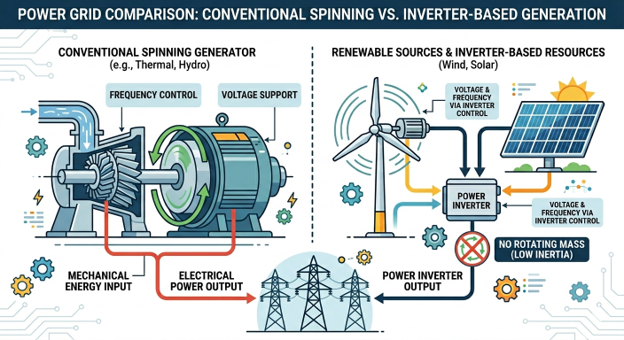
Source: AI generated diagram prompted by Atlantica staff on 2026-05-20.
The renewable electricity challenge
Wind and solar electricity generation is renewable but variable. These renewable energies come with many benefits but also some challenges. Wind turbines and solar panels generate electricity very differently from conventional power plants: they connect to the grid through electronic devices called inverters – devices that convert the variable electricity produced by wind and solar into the stable form the grid requires, but they lack spinning rotors to create inertia.
This problem is compounded because electricity demand across Atlantic Canada is becoming more volatile, especially as we electrify more. Traditional baseload (dispatchable) electricity generation plants can struggle to turn on or off quickly enough to fill in gaps between demand fluctuations and changes in the supply from renewable sources with the sun shining or wind blowing.
This is where synchronous condensers can be used as a shock absorber for the electrical system.
What is a synchronous condenser?
A synchronous condenser is essentially a large electric motor that spins in sync with the grid but doesn’t produce electricity or drive any machinery. Its entire job is to stabilize the grid, acting as a shock absorber that smooths out the effects of sudden changes in wind and solar generation output.
Think of it like a flywheel on a bicycle. When you stop pedalling, the flywheel keeps the wheel turning smoothly for a moment rather than stopping abruptly.
A synchronous condenser does the same thing for the electrical grid. Its heavy rotor resists sudden changes in frequency, giving grid operators the time they need to respond to a disruption. At the same time, its control system constantly monitors voltage across the grid, pushing reactive power in when voltage drops, absorbing it when voltage climbs too high. This happens continuously and automatically.
Synchronous condensers are not an alternative to wind and solar; they help make more wind and solar generation possible.
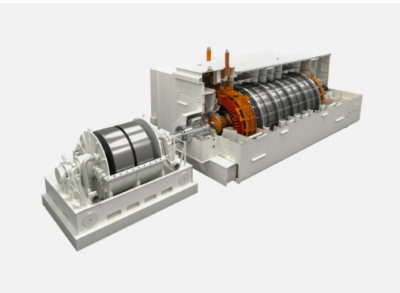
Source: Synchronous condenser, Siemens Energy.
Synchronous condensers in Atlantic Canada
Synchronous condensers are already being planned in Atlantic Canada.
Nova Scotia is installing 1000 MW of new wind projects to reach its goal of 80% renewable electricity. Each of these wind projects is having a synchronous condenser installed at the site. The Independent Energy System Operator of Nova Scotia has identified grid support as an essential part of the project, such as synchronous condensers. They will deliver voltage support to provide stability to the local electricity grid and ensure the wind farm is always able to operate. The synchronous condensers will also provide frequency support to the province overall.
The Renewable Integration Grid Security (RIGS) Energy Atlantic project is under consideration to be developed in Centre Village, New Brunswick, near Tantramar area. This 500 MW facility would be operated by PROENERGY Global Solutions Canada in partnership with NB Power. It is designed primarily as a grid support facility, not a conventional power plant.
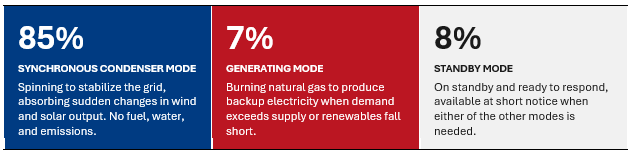
The facility will consist of 10 individual combustion turbines of 50 megawatts each. Most of the time, these turbines will run in synchronous condenser mode, spinning to stabilize the grid without burning any fuel. John MacIsaac, President of PROENERGY Global Solutions Canada, described the dual role this way on the Insights Podcast:
“More than once, it’s worth mentioning that roughly 85% of the time, the other mode of operation for this facility is that important synchronous condenser mode, where we’re using no fuel, using no water, and enabling grid stability for increased penetration of renewables.”
— John MacIsaac, President, PROENERGY Global Solutions Canada
The three operating modes of the RIGS facility illustrate how this synchronous condenser mode capable plant actually spends its time:
The facility is also designed to serve the broader region. NB Power has an option to resell 100 megawatts of its capacity to IESO Nova Scotia according to Brad Coady, Chief Commercial Officer, NB Power, making it a regional grid stability solution.
Nova Scotia is also pursuing its own fast-acting generation capacity closer to home. IESO Nova Scotia issued a Request for Expressions of Interest for the construction and operation of one or two 300-megawatt fast-acting natural gas-fired facilities in Pictou County, similar to the one under consideration in New Brunswick.
What is the role for synchronous condensers in Atlantic Canada’s net-zero future?
Electrical utilities across Atlantic Canada are planning to use more and more variable renewable electricity generation to help meet growing demand and manage costs while decarbonizing our grids. But to help keep our electrical system reliable, utilities will rely on several tools, including synchronous condensers.
For example, in Nova Scotia, wind generation and synchronous condensers are being paired to displace traditional coal generation.
In New Brunswick, once operational, the RIGS Energy Atlantic facility is expected to contribute to reduce New Brunswick’s net CO₂ emissions by 250,000 tonnes in its first year, equivalent to 106 million litres of gasoline not used or 125 million kg of coal not burned. That reduction does not come from the facility generating clean electricity, but from what it displaces. By stabilizing the grid, it reduces the need to run older, higher-emitting generating stations to cover for the unpredictability of renewables.
Resources
- RIGS Energy Atlantic
- Siemens Energy – Synchronous Condenser
- GE Vernova – Synchronous Condensers
- ScienceInsights – What Is a Synchronous Condenser and How Does It Work?
- ElProCus – Synchronous Condenser
- Atlantica Centre for Energy – Balancing the Grid 101
- Atlantica Centre for Energy – Integration 101
- Insights Podcast – RIGS Energy Atlantic with Brad Coady and John MacIsaac
- IESO Nova Scotia – Fast-Acting Natural Gas Generation Procurement
- IESO Nova Scotia – Fast-Acting Generation: Questions and Answers (November 2025)
- IESO Nova Scotia – Request for Expression of Interest
- Halifax Examiner – New Independent Agency Moving Fast to Build Natural Gas Plants in Nova Scotia
- Government of Nova Scotia – Clean Power Plan