
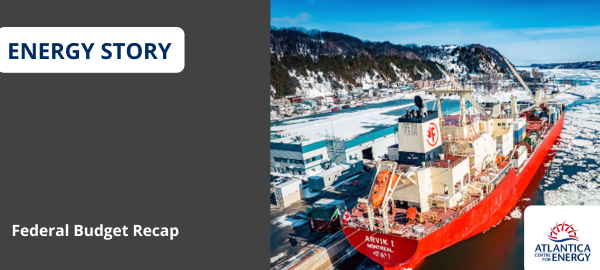
On Tuesday, November 4, 2025, the federal government released its long-awaited Budget 2025: Canada Strong. Budget 2025 introduced a Climate Competitiveness Strategy, which anchors several measures aimed at accelerating investment in energy projects and reducing regulatory barriers to growth, while transitioning to an increasingly low-carbon economy.
Economic Forecasts and Projected Spending:
Budget 2025 frames government spending in a new way to illustrate differences between investments and operating spending. The Budget proposes to enable $1 trillion in total investment over the next five years. Capital spending would increase from $32.2 billion last year to over $59 billion by 2029, however some experts point out that only about $8.3 billion of this increase is new.
The Budget forecasts the 2025-2026 deficit to be $78.3 billion, decreasing gradually to $56.6 billion in 2029-2030. The 2025-2026 deficit forecast is significantly higher than previously expected. However, the fiscal path maintains a declining deficit-to-GDP ratio. The federal government has also included plans to reduce its operating spending though the Comprehensive Expenditure Review, which aims to save $60 billion over five years.


Accelerating Investment:
For more detailed information on the investment incentives and grants outlined below, read Deloitte’s 2025 federal budget: Grants and incentives announcements and updates.
Investment Tax Credits: Budget 2025 commits to introduce legislation to establish the Clean Electricity Investment Tax Credit (ITC), which was announced, but not established, by the previous federal government. The Clean Electricity ITC was designed to allow provincial and territorial governments, as well as municipal and Indigenous corporations, to participate. The Clean Electricity ITC availability would be backdated to April 16, 2024 (for projects not under construction before March 28, 2023).
Several important changes were announced compared to the original design of the Clean Electricity ITC:
- Remove the conditions imposed preventing eligibility of Crown corporations of provincial and territorial governments.
- The federal government will also consult on domestic content requirements for this ITC.
Several additional changes are proposed for the four clean economy investment tax credits already in place:
- the Carbon Capture, Utilization and Storage ITC:
- Allow full credit rates to apply from 2031 to 2035 (remaining unchanged from 2036 to 2041).
- the Clean Technology ITC:
- Eligibility will be expanded to include systems producing electricity, heat or both from waste biomass, retroactive to November 21, 2023.
- Changing eligibility requirements for small nuclear energy property, retroactive to March 28, 2023.
- The federal government will also consult on possibly domestic content requirements for this ITC.
- the Clean Hydrogen ITC:
- Expand eligibility to hydrogen produced from methane pyrolysis as of December 16, 2024.
- the Clean Technology Manufacturing ITC:
- Expanding the list of eligible critical minerals to include antimony, indium, gallium, germanium and scandium.
- Include equipment used in eligible polymetallic mining projects as of January 1, 2024.
Capital Cost Allowances (CCAs): Budget 2025 proposed several changes to incentive investments in production and equipment across several sectors, including energy. These incentives (termed the Productivity Super-Deduction) include:
- Reinstating the Accelerated Investment Incentive, which provides an enhanced first-year write-off for most capital assets. Immediate expensing (100% first-year write-offs) include energy generation and conservation equipment, zero-emission vehicles, manufacturing and processing equipment, patents, data and network infrastructure, scientific research.
- Other important incentives include immediate expensing for manufacturing and processing buildings and CCAs for low-carbon LNG facilities (before 2030). There would be a four-year phase out period after 2030.
Major Projects Office (MPO): The MPO will help coordinate and structure financing for major projects will all private and public sector partners including the Canada Infrastructure Bank, Canada Growth Fund, and the Canada Indigenous Loan Guarantee Corporation.
Canada Infrastructure Bank (CIB): The federal government plans to increase CIB investment by $10 billion (from $35 billion to $45 billion). The CIB will also be able to invest in any nation-building projects (referred to the MPO).
Indigenous project support: The CIB’s target for Indigenous infrastructure investments will increase to at least $3 billion (from at least $1 billion). The Canada Indigenous Loan Guarantee Corporation will also be directed to work with Indigenous investors on new build projects.
Biofuels: A Biofuels Production Incentive will begin next year (2026-2027) to support domestic biodiesel and renewable diesel production. A total of $372 million will be provided over two years ($175.2 million will be repurposed from the Clean Fuels Fund).
Sustainable Bond Framework: The federal government intends to develop a Framework to allow green and transition bonds (in-line with a green taxonomy) to support industrial and agricultural sectors improve competitiveness and decarbonize.
Regulatory Impediments:
Budget 2025 plans to remove unnecessary regulatory impediments to developing energy and other natural resources projects. Several changes are proposed related to conventional fuels in particular, where tighter carbon pricing (Output-Based Pricing Systems (OBPS)) and methane regulations, combined with investments in carbon capture and storage (CCS), are favored over the proposed oil and gas sector emissions cap.
Changes outlined in Budget 2025 include:
- Carbon pricing/OBPS: The federal government is committed to maintaining annual price increases under these systems until 2030, and will develop a post-2030 carbon pricing directory that targets net-zero by 2050. The federal government will also work to ensure all provincial and territorial industrial pricing systems are harmonized (e.g. improvements linking carbon credit markets).
- Clean Electricity Regulations: Legislative amendments were proposed for the Canadian Environmental Protection Act to make longer-term agreements with provinces.
- Clean Fuel Regulations: Budget 2025 proposed to make amendments to the Regulations to strengthen the domestic supply of biofuels. These changes will be complemented by the creation of a Biofuels Production Incentive to support domestic biodiesel and renewable diesel production.
- Methan regulations: The federal government will finalize enhanced methane regulations for the oil and gas sector and landfills.
- Oil and Gas Emissions Cap: The federal government no longer plans to finalize the proposed Oil and Gas Emissions cap.
- Greenwashing: The federal government intends to remove the requirement for businesses to prove environmental benefit claims based on internationally recognised standards. As well, changes are proposed to limit the ability of third parties to bring complaints directly to the Competition Tribunal.
- Carbon contracts for difference: The Canada Growth Fund will continue to issue contracts to support long-term investments.
- Electric vehicle (EV) mandates: The federal government committed to removing the 2026 target from the Electric Vehicle Availability Standard and will review the regulation. More changes will be announced in the coming weeks.
- Red tape reduction: Several changes were outlined in Budget 2025 to reduce red tape and improve the flexibility and efficiency of government. These changes include providing federal ministers with authority to create regulatory sandboxes to help test products, services, processes, or new regulatory approaches.
Other Budget highlights include:
- Green taxonomy: The federal government continues to support made-in-Canada investment guidelines, which will be finalized by the end of 2026. This will be a voluntary tool.
- Climate disclosure: The federal government will work with provinces and territories to improve climate disclosure, including harmonization across Canada, and aligning with international standards.
- Household data: The federal government will develop new metrics to show energy exports, grow in the clean sector, and how businesses and households are reducing their emissions.
- Wind West: Budget 2025 highlighted the economic and energy potential of the Wind West plan and Eastern Energy Partnership. However, little new information was provided.
- LNG Export: The Canadian Energy Regulator will increase maxim export licenses for LNG from 40 to 50 years.
- Trade diversification: The federal government announced a Trade Diversification Corridors Fund to strengthen supply chains, unlock new export opportunities, and build a more resilient, diversified economy.
Select stakeholder feedback:
“The Clean Electricity ITC will help to build critical infrastructure like interprovincial transmission and will begin to level the playing field for municipalities and Indigenous companies. However, by failing to provide Indigenous companies and communities with an ITC rate that is equivalent to their non-Indigenous competitors and collaborators, the federal government has not meaningfully addressed a significant barrier to Indigenous equity ownership of renewable energy and energy storage projects.”
– Fernando Melo, Senior Director of Public Affairs and Federal Policy, CanREA
“There is a lot in this budget that we need to further analyze and seek clarity on, though my initial reaction is cautiously optimistic. We see movement on a number of initiatives for the energy industry that are important and that should help the industry grow. A signal that the emissions cap may come to an end is positive, along with support for major projects, and having another look at greenwashing legislation.”
– Charlene Johnson, CEO, Energy NL
“The Clean Electricity ITCs will support investment in electricity infrastructure and help keep electricity affordable. It’s important that this becomes a reality. Let’s get building.”
– Francis Bradley, President and CEO, Electricity Canada
“The inclusion of Investment Tax Credits (ITCs) for biomass projects in Budget 2025 is a welcome, long-overdue step for Canada’s forest sector. After years of uncertainty, the measure offers a starting point to restore investor confidence, but its impact will depend on how quickly and clearly the federal government follows through.”
– Derek Nighbor, President and CEO, Forest Products Association of Canada
More information:
- Canada’s Budget 2025 (PDF)
- Canada’s Climate Competitiveness Strategy
- Budget 2025 News Release
- Deloitte: 2025 federal budget: Grants and incentives announcements and updates.