
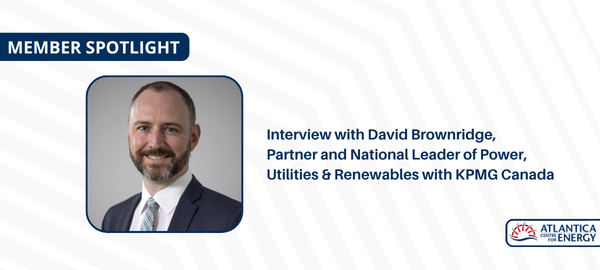
The Atlantica Centre for energy recently interviewed David Brownridge, Partner and National Leader of Power, Utilities & Renewables with KPMG Canada, to better understand the company’s work in Atlantic Canada.
David, please tell us about KPMG Canada. What's your background and role within the company?
Our model is to be present in the communities we serve while drawing on the firm’s national and global capabilities when specialized expertise is needed. That allows us to bring together the right people for each organization and situation.
I’m a Chartered Professional Accountant and have spent more than 19 years with KPMG. My background is in audit and accounting advisory, with a particular focus on the power, utilities and renewables sector. I currently serve as KPMG Canada’s National Leader, Power, Utilities and Renewables.
A central part of my role is being a connector. I bring together team members with specialized expertise and experience from across the firm to help energy organizations make informed decisions and execute effectively. That can involve working with Crown corporations, publicly traded companies, utilities and independent power producers across wind, solar and other forms of generation.
What kind of support does KPMG Canada offer to businesses working in the power, utilities and renewables?
David: The work depends on the organization, the project and the relationship. We support organizations across audit, tax and advisory, including infrastructure planning and capital-project delivery, regulatory strategy, accounting, risk management, sustainability, digital transformation, governance and reporting.
From an audit perspective, KPMG has a significant presence across Canada’s power and utilities sector. Outside of audit, we support organizations in areas including infrastructure planning and capital project delivery, regulatory and risk matters, indigenous advisory, and the frameworks companies need to navigate as they deliver major projects.
We also work in sustainability, from strategy and execution through to reporting. More recently, that has included helping clients navigate federal Investment Tax Credits, bringing together our tax and infrastructure professionals to help organizations understand the requirements and support their claims.
A recent example is the federal Clean Electricity Investment Tax Credit. Our tax and infrastructure professionals can help organizations assess eligibility, understand the applicable labour requirements and establish the documentation and governance needed to support a claim.
Those requirements are important. Where they apply, organizations must address prevailing-wage and apprenticeship obligations to access the regular credit rate.
Our Indigenous Advisory Services team also works extensively in this space. One aspect of that work is helping structure partnerships between Indigenous communities and organizations undertaking significant energy investments. These arrangements can support meaningful participation while helping projects reflect community priorities and create longer-term economic opportunities.
Digital technology and artificial intelligence are also becoming increasingly relevant. Energy organizations are considering how these technologies can support their operations, while putting the appropriate governance, risk management and controls around their use.
Given your presence in Newfoundland and Labrador, Nova Scotia, and New Brunswick, you must be pretty familiar with the different regulators and what their processes are. Is that knowledge another layer of expertise you provide?
The regulator’s role is to determine just and reasonable rates while protecting the interests of energy consumers. That is particularly important given the scale of investment expected in energy infrastructure. Those investments ultimately need to be paid for, so regulators must balance the need for additional supply and system reliability with affordability and the way costs are allocated. Canadian jurisdictions have many similarities, but each province also has its own regulatory framework, priorities and customer considerations. There is value in bringing lessons from other jurisdictions, but those lessons always need to be adapted to the local context.

David Brownridge
Partner and National Leader of Power, Utilities & Renewables, KPMG Canada
Many energy sector businesses operating in Atlantic Canada and elsewhere across Canada also have U.S. operations and infrastructure. With ongoing trade disputes between Canada and the United States, it appears that as of October 1st, 2026, energy has been left largely exempted from these tariffs. What are the other impacts that you've seen, if any, from this trade conflict on the energy sector?
Some of the large components that are sourced outside of Canada, at least today, have been within CUSMA, which then means that they are still coming in effectively tariff-free. Many of the largest suppliers to the energy sector operate globally, which may give them some flexibility to adjust sourcing and production. Over the longer term, however, the situation is prompting organizations to look more closely at the resilience of their supply chains.
That includes considering where critical components come from, what can be sourced domestically and whether longer-term supplier relationships could provide greater certainty. In some cases, long-term contracts may help give suppliers the confidence to invest in additional capacity.
Labour is also a significant component of major energy developments and is not directly exposed to tariffs. Canada’s electricity trade has historically flowed more from north to south than from east to west. Those trading relationships will likely continue to be important. At the same time, current trade uncertainty is contributing to a broader discussion about where greater interprovincial transmission could improve resilience and make better use of Canadian generation resources.
That leads to the question of regional coordination. Atlantic Canada has existing interties and additional projects under consideration. The opportunity is to determine how utilities and governments can plan more collaboratively, identify what can be built cost-effectively and provide investors with the confidence to develop new facilities.
Let's talk about the investment landscape in Canada. How have electricity and renewables investments or the landscape for them changed since January 2025 between Canada and the United States?
That aligns with what we’re seeing in KPMG’s global energy research as well. The investment conversation increasingly comes back to balancing energy security, affordability and sustainability with the capital and infrastructure required to meet growing demand.
One area where we are seeing renewed interest is nuclear. It has long been an important part of Ontario’s electricity system, and we’re seeing that conversation broaden across Canada. Saskatchewan and SaskPower recently announced a decision to advance nuclear power development, while here in Atlantic Canada, NB Power continues to operate the Point Lepreau Generating Station. In the U.S., there is significant capital being deployed as well, reflecting the overall size of that market.
Government incentives, including Investment Tax Credits, can also help improve project economics by reducing the cost of capital. The important thing, though, is that incentives don’t inadvertently drive project timelines. Large energy projects can require years of engineering, consultation, environmental assessment and regulatory work before construction begins. That upfront planning is critical.
We’ve seen examples where major projects have encountered challenges because enough work wasn’t done at the planning stage. Incentives can be helpful, but they shouldn’t change the discipline required to develop and execute these projects well. The work done before construction begins can be just as important to a project’s long-term success as the construction itself.
From an Atlantic Canada perspective, we have significant natural advantages for clean-energy development, including hydroelectricity and both onshore and offshore wind. At the same time, the broader question for Canada is how we build an energy system that can meet growing demand reliably and affordably.
For me, that means taking a practical view of the energy mix. Different regions have different resources, infrastructure and needs. Rather than focusing on any one technology, the priority should be creating the conditions for long-term investment while balancing reliability, affordability, sustainability and the ability to actually deliver projects.
Can you talk to predictability or confidence outside investors would need to make longer-term clean energy investments?
Consistency does not mean that policies can never change. It means organizations need enough visibility to understand the requirements, assess the risks and make decisions with confidence.
Investment tax credits can help by lowering capital costs and reducing the amount that ultimately needs to be recovered from electricity customers. That can support both project economics and affordability.
The recently proposed Productivity Mega Deduction could also be significant. By providing immediate expensing for a broader range of eligible investments, it could improve near-term cash flow and strengthen the economics of major capital projects.
Measures like these can help de-risk investment, but they are most effective when they operate alongside clear regulation, efficient permitting and disciplined project planning.
We've talked about the things that have been done to try and accelerate investment here in the energy sector, especially with power utilities and renewables. What else do you think Canada or Atlantic Canada should be doing to really capitalize on this moment that we have?
There is a desire to move quickly when investment conditions are favourable, but projects also need to be developed carefully. We should apply the lessons from previous major developments and make sure the right work is done at the beginning.
These assets may operate for several decades The policies and relationships supporting them therefore need to be durable. Effective alignment among municipal, provincial, and federal requirements can help improve project coordination while maintaining the integrity of the review process
The same principle applies to environmental assessments. The objective should not be to avoid appropriate scrutiny. It should be to make requirements clear, coordinated and predictable so that organizations can take the necessary steps and move projects forward efficiently while protecting the environment.
For Atlantic Canada, regional planning is especially important. The region has substantial generation potential, but the population and industrial demand are not always located where that power can be produced.
Transmission is therefore a critical part of the discussion. The region needs to consider where future electricity will be used, how it will reach those markets and how the costs and benefits of supporting infrastructure should be shared.
“Atlantic Canada has significant potential to generate power, but generation isn’t always located where the demand is. The opportunity is to think more regionally about how we connect our resources, strengthen transmission and get power to the communities, industries and markets that need it.”
– David Brownridge
In August, the Atlantic team visited KPMG's team in St. John's. It was actually the same week as the historic Churchill Falls MOU announcement by Premier Wakeham, Prime Minister Carney, and the Premier of Quebec as well. What do you think this announcement could mean for Eastern Canada and Canada more broadly?
It is about more than one generating facility. It shows how governments and utilities can work through long-standing issues, connect resources with markets and support energy security and long-term economic growth.
The geography of Canada means the best locations for generating electricity are not always close to the population centres and industries that need it. That creates a need for collaboration across provincial boundaries, including decisions about transmission, financing, cost sharing and long-term market access.
The new Churchill Falls framework is a useful example of parties looking beyond historical disagreements and focusing on future opportunities. It may also provide lessons for other parts of Canada, where greater interprovincial coordination could help make better use of different generation resources.
Canada does not operate as a single electricity grid. Geography, provincial jurisdiction and the way regional systems have developed all contribute to that reality. However, stronger connections between provinces can provide benefits by allowing regions to share resources, manage demand and draw on different forms of generation when they are most needed.
A sustainable-finance taxonomy is being developed in Canada. Can you explain what it is and why it matters?
The objective is to establish a common reference point that investors, lenders and organizations can use to understand how different activities and investments are categorized. This can include classifications related to green and transition activities, among others.
There are currently different frameworks and approaches in the market, which can make comparisons challenging. A Canadian taxonomy could provide an additional reference point for organizations and investors when evaluating opportunities and communicating how investments are classified.
Importantly, a taxonomy is a classification framework. It does not determine whether a particular investment, technology or project is appropriate for an organization. Those decisions still depend on factors such as project economics, organizational objectives, risk, reliability, affordability and broader market conditions.
Is there anything else that you'd like to add?
Electricity is an input into the broader economy, and drives growth. As demand grows, the focus needs to be on creating the conditions to deliver reliable and affordable energy that can support Canada’s long-term economic needs, while recognizing that different regions will have different resources, needs and pathways.
For me, it comes back to taking a practical, long-term view. Different regions have different resources, infrastructure and priorities, so there isn’t a single approach that will work everywhere. The opportunity is to make thoughtful investments, strengthen the infrastructure needed to support communities and industries, and ensure the decisions we make today can serve Canadians over the long term.