
The Canada Regulator released its bi-annual energy forecasts on March 17, 2026. Canada’s Energy Future 2026: Energy Supply and Demand Projections to 2050 (EF2026) aims to help foster informed conversations about Canada’s energy challenges and trends into the long-term future. In the past, previous versions of the report have been used by the federal government, among others, to help develop policies that shape the future of energy and emission reduction across the Country.
For 2026, the report shares four long-term scenarios (until 2050) for Canada’s energy system:
- Current Measures;
- Higher;
- Lower; and,
- Canada Net Zero.
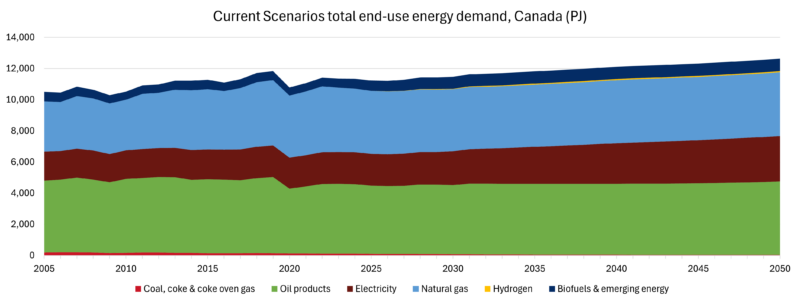
The Current Measures scenario provides a baseline estimate for future energy supply and demand based on current government policies, expected technological and economic growth, among other considerations. The Higher and Lower scenarios differ mostly based on the expected level of industrial demand growth (e.g. data centres, etc.). The Canada Net Zero scenario explores what a pathway to net-zero emissions by 2050 could look like in Canada.
It is important to recognize that Canada’s Energy Future is not a forecast or prediction of the future.
Select highlights for Canada:
- The demand for electricity is expected to increase across all scenarios as homes and industry use more.
- Additional electricity supply will come mostly from renewable sources.
- Natural gas production will accelerate across all scenarios.
- Expanding natural gas production (and production gains for oil) could strengthen Canada’s global exports.
- Canada will continue exporting energy to the United States.
Select highlights for Atlantic Canada:
- Electricity consumption and production will increase significantly in all scenarios, driven by renewable generation.
- Biofuels and natural gas demand is expected to be steady.
- The Current Measures scenario assumes hydrogen produced for export
- increases after 2030, reaching 2 million tonnes (MT) by 2050.
- Oil products are forecasted to increase in the medium-term in NL (likely related to the Bay du Nord project) before decreasing in the long-term.
- The report assumes 73 offshore wind turbines (reference capacity of 15MW each) are installed in Current Measures.
- The role of biofuels, such as sustainable aviation fuel, increases in all scenarios.


Next steps:
The Atlantica Centre for Energy will study the EF2026 in more detail and share additional information on what the data predicts for Atlantic Canadians, and how it lines up with local utility forecasts.
Resources:
- Canada Energy Regulator, Canada’s Energy Future 2026: Energy Supply and Demand Projections to 2050
- Canada Energy Regulator, Canada’s Energy Future 2026 dataset
- Canada Energy Regulator, Canada’s Energy Future 2026 Data Viz tool
- Canada Energy Regulator, Canada’s Energy Future 2026 news release