
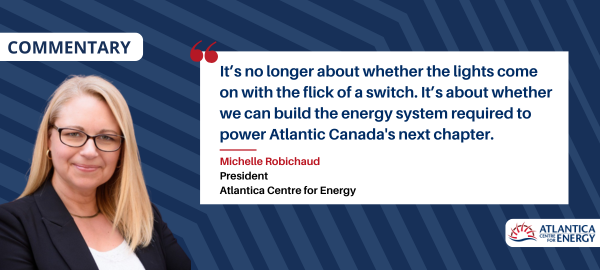
Commentary by Michelle Robichaud, President of the Atlantica Centre for Energy.
A few weeks ago, I was trying to explain to one of my daughters why I spend so much time talking about energy and electricity.
She looked at me and said, “Mom, the lights come on when I flip the switch. What else do I need to know?”
For the last several decades, that might have been enough.
Energy worked best when nobody had to think about it. It was a utility service operating quietly in the background while we focused on economic development, housing, healthcare, workforce challenges, and trade.
Today, that has changed. Increasingly, energy is no longer just something we consume. It is something that enables.
It enables housing.
It enables industrial development.
It enables transportation electrification.
It enables data centres and AI.
It enables national security.
And ultimately, it enables economic growth.
For the first time in generations, Atlantic Canada may have more opportunities than the energy available to support them. That is a remarkable shift.
For decades, utilities planned around relatively stable demand, predictable growth, and long-term infrastructure cycles. Then came a series of disruptions: supply chain challenges, inflation, population growth, geopolitical instability, electrification policies, and the rapid emergence of energy-intensive technologies.
The world changed faster than many of our planning assumptions.
At the same time, energy has become increasingly political. As affordability pressures rise, households feel the impact directly through their monthly bills. Across Atlantic Canada, energy affordability is a real concern, and many households spend a larger share of their income on energy than the national average.
Yet while affordability matters, the region’s challenge is much broader.
Atlantic Canada faces the need for major reinvestment in generation, transmission, and supporting infrastructure. We need more electricity. We need greater system resilience. We need to support economic growth while continuing to reduce emissions. And we need to do it all in a region with relatively small rate bases and limited ability to absorb the cost of that investment.
In short, Atlantic Canada does not have the luxury of making large mistakes. But it also does not have the luxury of standing still.
This reality led the Atlantica Centre for Energy to convene utilities, industry leaders, Indigenous partners, governments, and communities from across the region to explore what a more collaborative energy future could look like.
What emerged was not a discussion about a lack of resources. Atlantic Canada has world-class energy assets. We have hydro resources, exceptional wind potential, nuclear expertise, deep-water ports, and skilled workers.
The challenge is not resources. The challenge is alignment.
And when we talk about energy, we are not talking only about electricity. We are talking about the full energy system: electricity, natural gas, liquid fuels, and the infrastructure that connects them. Economic growth doesn’t happen because one part of the system succeeds. It happens when the system works together.
Again and again, participants pointed to the same issues: affordability pressures, aging infrastructure, reliability concerns, economic growth constraints, and increasing expectations from governments that provinces work together to unlock large-scale investments.
Investors do not evaluate Atlantic Canada as four separate electricity systems competing with one another. They evaluate whether the region as a whole can provide affordable, reliable, secure energy and a stable environment for investment.
That is why regional collaboration matters.
Not collaboration for its own sake, but collaboration that improves outcomes.
We already have examples of what this looks like. The Maritime Link, the Wasoqonatl Transmission Line (NS-NB Reliability Tie), and the subsea connections to Prince Edward Island all demonstrate that regional cooperation can deliver real benefits. But these projects were often pursued to solve a specific problem at a specific moment in time.
The opportunity now is to move beyond project-by-project collaboration and begin planning regionally before constraints emerge, rather than after they do.
Shared planning assumptions, regional modelling, coordinated investments, and better understanding of common risks can help reduce duplication, improve system efficiency, and strengthen long-term competitiveness.
The discussion is also evolving nationally.
Regional collaboration also gives us the opportunity to think bigger than any one province can on its own and building a system capable of supporting the next generation of transformative projects. Ones that could reshape Atlantic Canada’s economic future, create new industries, strengthen energy security, and position the region as a leader in supplying the energy the country will increasingly need.
Recent federal policy discussions increasingly position electricity as foundational to economic growth, industrial competitiveness, manufacturing, AI development, and energy security. This represents an important shift. Energy policy is no longer being viewed solely through the lens of emissions reduction. It is increasingly being discussed in terms of competitiveness, sovereignty, affordability, and economic resilience.
For Atlantic Canada, this presents both a challenge and an opportunity.
The challenge is attracting the investment needed to modernize and expand our energy systems.
The opportunity is that our region possesses many of the ingredients needed to succeed: abundant resources, strategic geography, growing Indigenous participation, and a willingness to explore more collaborative approaches.
But none of this happens without public confidence.
Energy literacy remains one of the most overlooked aspects of the conversation. People are increasingly being asked to weigh in on complex energy decisions without having been taught how energy systems actually work. Building understanding and trust will be essential if we hope to build the infrastructure needed for the future.
Ultimately, the question facing Atlantic Canada is not whether we have enough resources, because we do. The question is whether we can align those resources quickly enough to compete.
Because while energy may be the subject of the conversation, growth is the story.
It’s no longer about whether the lights come on with the flick of a switch.
It’s about whether we can build the energy system required to power Atlantic Canada’s next chapter.