
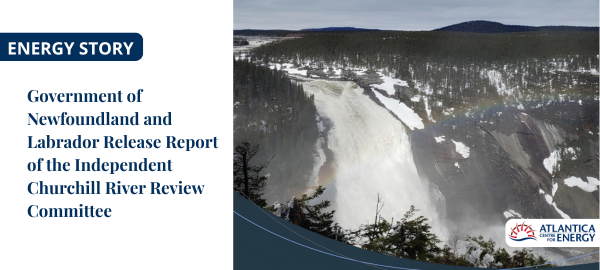
On May 19, 2026, the Government of Newfoundland and Labrador released findings from the Churchill River Independent Review Committee on the Memorandum of Understanding (MOU) signed between Newfoundland & Labrador Hydro and Hydro-Quebec in December 2024 regarding the future of electricity generation on the Churchill River.
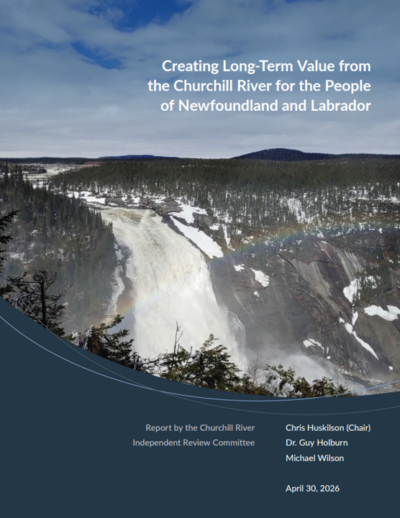
The Independent Review Committee’s Report: Creating Long-Term Value from the Churchill River for the People of Newfoundland and Labrador, was completed between December 15, 2025 and April 30, 2026. The Committee’s work studied the financial and economic benefits of the MOU, as well as its associated risks. In consultations, the Committee interviewed many stakeholders and received more than 350 submissions.
Report findings:
The Independent Review Committee found the MOU has important aspects and benefits for Newfoundland and Labrador, but is not in the best long-term interests of the province as currently written.
“We conclude this, in part, because of limitations in the MOU that were also a feature of the 1969 Churchill Falls Power Contract (as renewed in 2016). Specifically, these are limited rights to use Churchill Falls power in the province over an extended period, problematic power pricing models, governance control by a minority shareholder who is in a conflict-of-interest position as a major customer, and restricted access to transmission infrastructure that would enable power generated in Labrador to reach export markets. In our view, the Government of Newfoundland and Labrador has several significant decisions to make that could ultimately make the MOU serve the public interest.”
– Churchill River Independent Review Committee
The Committee’s concerns with the MOU focused on a lack of potential for the province’s utility to export electricity itself (transmission access) or use electricity to support economic development projects (particularly in Labrador) under the current agreement.
Concerns were also raised with electricity pricing and revenue allocation, as well as governance arrangements with Hydro-Québec’s dual role as a purchaser and shareholder.
However, the Committee supports pursuing a new MOU to address the concerns identified.
The Report’s five recommendations for next steps are:
- The provincial government conduct, based on a comprehensive analysis of long-run economic development options, the extent to which power generation from the Churchill River should provide financial versus economic value to the province over time.
- GNL should sanction and support Newfoundland and Labrador Hydro (NLH) construction of new transmission line capacity between Churchill Falls and Labrador West in order to enable economic growth of the province’s energy-intensive industries.
- GNL and NLH should remain committed to the objective of building respectful relationships with and consulting Indigenous communities in connection with future developments on the Churchill River and in Labrador.
- GNL should rigorously evaluate alternative ownership, operating, and right-of-use models for new hydroelectric generation at Gull Island that are consistent with the province being the primary beneficiary of the financial and economic value created.
- GNL and NLH should prepare for future negotiations with Hydro-Québec (HQ) by preparing a fully articulated negotiation strategy and best-practice governance process.
New negotiating team:
The Government of Newfoundland and Labrador is “prepared to commence” new negotiations, and still “welcome Hydro-Québec” as its partner. Premier Wakeham announced a new three-member team to represent the province in negotiations:
- Barry Perry, former president and CEO of Fortis Inc., will serve as lead negotiator.
- Jerome P. Kennedy, KC, St. John’s lawyer and former cabinet minister in the Government of Newfoundland and Labrador.
- Jennifer Williams, president and CEO of Newfoundland and Labrador Hydro.
Future negotiating priorities:
Premier Wakeham identified three priorities for the new negotiating team in pursuit of a new MOU with Hydro-Québec:
- More power in order to develop the province’s own economy and, in particular, the industrial and mining opportunities tied to critical minerals in the Labrador Trough.
- More value from the Power Purchase Agreements the agreement is centered around, including a pricing structure for Gull Island that would not leave the province with stranded debt at the agreement’s conclusion.
- More transmission through Québec so the province could retain an option to sell an allotted supply of electricity at market rates.
The Premier also noted the provincial government remains committed to developing Churchill Falls and Gull Island.
What is next?
The Government of Newfoundland and Labrador has officially reached out to the Government of Québec to outline its position after the Report’s release. Premier Wakeham also called on the federal government to join forthcoming negotiations, in-line with federal priorities to develop major projects (which could include Gull Island and critical mineral mines in Labrador).
The negotiating timeline remains uncertain, but all parties may be motivated to quickly find a mutually beneficial agreement.
Resources:
- Report by the Churchill River Independent Review Committee: Creating Long-Term Value from the Churchill River for the People of Newfoundland and Labrador
- Technical Briefing: https://www.churchillriverreview.ca/files/ChurchillRiverTechnicalBriefing.pdf
- News release: https://www.gov.nl.ca/releases/2026/exec/0519n01/
- Premier Wakeham’s speaking notes: https://www.gov.nl.ca/releases/files/2026/05/Premiers-Speaking-Notes-May-19-2026.pdf
- Newfoundland and Labrador Energy Resources Map: https://www.atlanticaenergy.org/energy-knowledge-centre/energy-maps/newfoundland-and-labradors-energy-resources/
- Newfoundland and Labrador Hydro, Our Electricity System, Our Generation Assets: https://nlhydro.com/about-us/our-electricity-system/our-generation-assets/